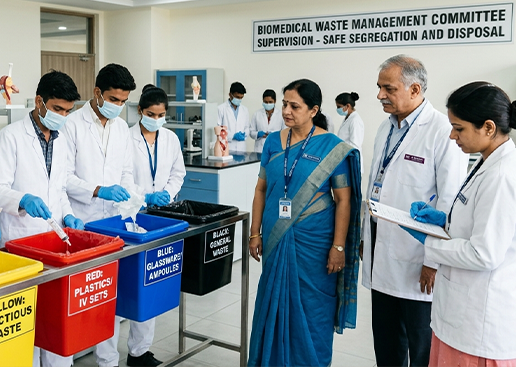
Biomedical Waste Management Committee (BMWMC)
About the Committee
The Biomedical Waste Management Committee (BMWMC) has been constituted by the College
to ensure the safe, scientific, and systematic management of biomedical waste generated
from laboratories, clinical training areas, and healthcare-related academic activities.
The Committee functions in accordance with the Biomedical Waste Management Rules, 2016
and subsequent amendments, and follows best practices adopted by leading healthcare and
allied health institutions to safeguard human health, ensure environmental protection,
and maintain statutory compliance.
Vision
To establish a safe, hygienic, and environmentally responsible campus by implementing
effective biomedical waste management practices and fostering a culture of awareness,
accountability, and compliance.
Objectives
- Ensure strict compliance with Biomedical Waste Management Rules, 2016
- Promote proper segregation, collection, storage, transportation, and disposal of biomedical waste
- Minimize health hazards, infections, and environmental risks
- Create awareness and responsibility among students, faculty, laboratory personnel, and support staff
- Encourage safe, sustainable, and eco-friendly waste management practices
- Ensure regular training, monitoring, and documentation
Roles & Functions of the Committee
- Formulate and implement the Biomedical Waste Management Policy and SOPs
- Ensure segregation of waste at source as per prescribed color-coding norms
- Monitor safe handling, labeling, storage, and disposal of biomedical waste
- Coordinate with authorized biomedical waste treatment facilities
- Conduct regular inspections, audits, and compliance reviews
- Organize training programs, workshops, and awareness sessions
- Maintain statutory records, registers, and reports
- Recommend corrective and preventive actions in case of non-compliance
- Ensure availability and proper use of Personal Protective Equipment (PPE)
Biomedical Waste Management Policy
Policy Statement
The College is committed to ensuring safe, scientific, and environmentally sound
management of biomedical waste generated during academic, laboratory, and clinical
activities to protect students, staff, public health, and the environment.
Scope
- All faculty members and non-teaching staff
- Students, interns, and trainees
- Laboratory and technical staff
- Housekeeping and support staff
- All laboratories, clinics, and healthcare training areas
Responsibilities
Biomedical Waste Management Committee
- Overall supervision, monitoring, and policy implementation
Heads of Departments / Laboratory In-charges
- Ensure compliance and segregation at source
Faculty, Students & Staff
- Follow BMW guidelines strictly and report incidents
Housekeeping Staff
- Safe handling, collection, and transportation of waste using PPE
Waste Segregation & Color Coding
- Yellow: Infectious and anatomical waste
- Red: Contaminated recyclable waste
- White (Translucent): Sharps
- Blue: Glassware and metallic items
Training & Awareness
- Mandatory induction and periodic training programs
- Display of BMW guidelines and charts at strategic locations
Monitoring & Review
- Regular audits and inspections
- Annual review of policy effectiveness
- Implementation of corrective and preventive measures
Standard Operating Procedures (SOPs)
SOP–1: Biomedical Waste Management in Laboratories
Purpose:
To ensure safe and compliant management of biomedical waste generated in teaching and diagnostic laboratories.
Procedure:
- Segregation at source immediately after waste generation
- Use of labeled, color-coded containers
- Disposal of sharps in puncture-proof containers
- Chemical treatment of liquid waste before disposal
- Waste bags not to exceed ¾ capacity
Safety Measures:
- Mandatory use of PPE
- Immediate reporting of spills, injuries, or needle-stick incidents
- Availability of spill management kits
Documentation:
- Daily waste generation records
- Incident and accident registers
Committee Composition
The Biomedical Waste Management Committee consists of faculty members,
laboratory in-charges, technical staff, and administrative representatives
responsible for effective implementation and monitoring.
(Committee members are notified separately as per institutional norms.)